
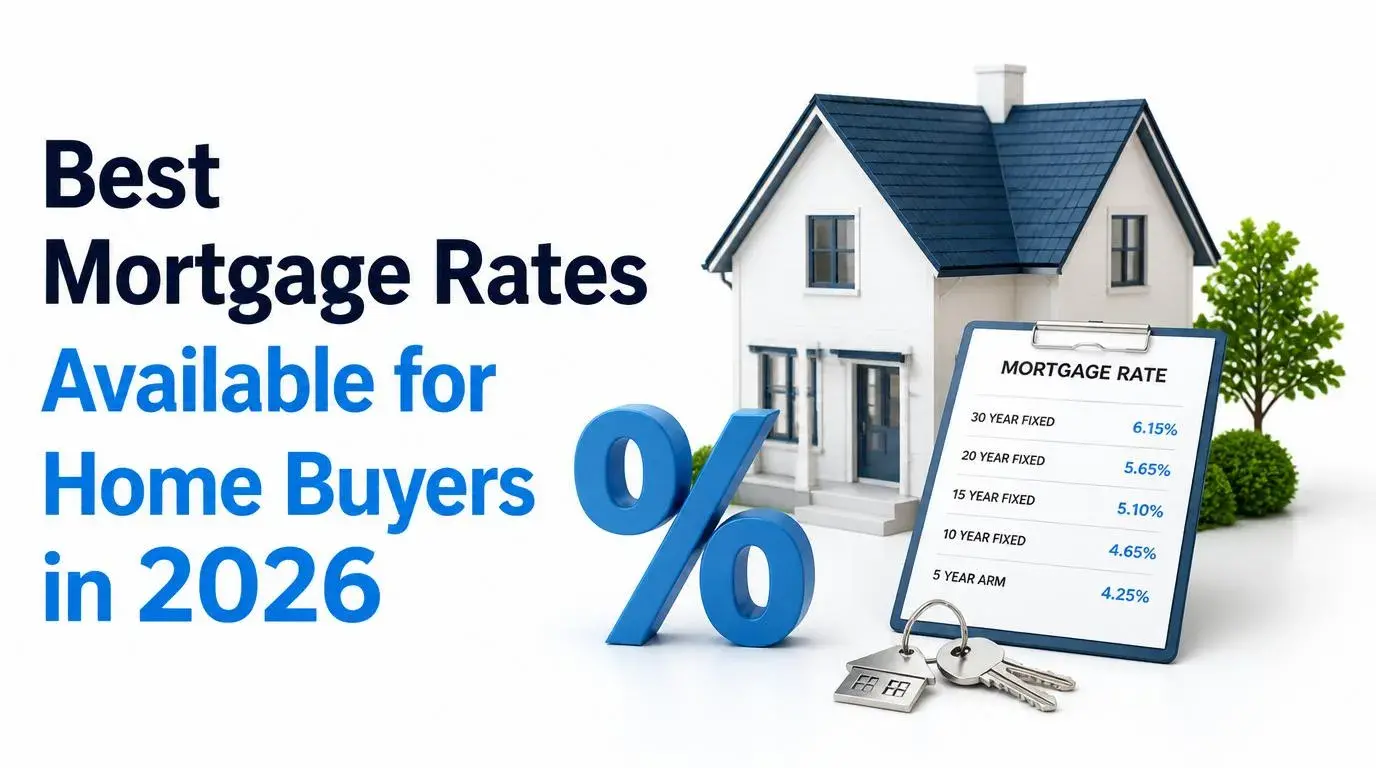
Best Mortgage Rates Available for Home Buyers in 2026
Finding the best mortgage rates available for home buyers in 2026 requires more than glancing at advertised averages. After peaking near 8% in late 2023, mortgage rates have settled into a range of approximately 5.5% to 6.5% for well-qualified borrowers, depending on loan type, down payment, credit score, and lender. For a $400,000 home with 20% down at 6.25%, your monthly principal and interest payment would be roughly $1,970—historically moderate compared to the 1980s (18% rates) but significantly higher than the 3% rates of 2020-2021. The key takeaway: rates are not returning to 3% anytime soon, but smart shopping can still secure competitive terms.
This guide provides a framework for understanding current rate environments, comparing loan products, and negotiating with lenders. While precise rates change daily based on market conditions, the principles below—credit optimization, debt-to-income management, shopping multiple lenders, and understanding the true cost of a loan—remain constant. Whether you’re a first-time buyer with a modest down payment or a move-up buyer with excellent credit, you’ll find actionable strategies to secure the lowest possible mortgage rate in today’s market.
Current Mortgage Rate Environment: What You Need to Know
Before diving into specific best mortgage rates available for home buyers in 2026, it’s essential to understand the factors driving today’s rate environment. As of mid-2026, the following dynamics are at play.
The Federal Reserve’s Role: After three rate cuts in late 2025, the Federal Reserve has paused its easing cycle in 2026. The federal funds target range currently sits at 3.50–3.75%. While the Fed doesn’t directly set mortgage rates, its policy influences the bond yields that do. Most economists expect the Fed to hold rates steady through mid-to-late 2026, with potential modest cuts by year-end if inflation continues its gradual decline.
Inflation Trends: Inflation has moderated significantly from its 2022 peaks (9.1%) but remains above the Fed’s 2% target. As of mid-2026, headline CPI is running in the 3–4% range, while core inflation (excluding food and energy) is closer to 2.5–3%. This “higher-for-longer” inflation environment keeps upward pressure on mortgage rates compared to the 2020-2021 period.
Economic Growth and Employment: The U.S. labor market remains resilient, with unemployment near historic lows (3.5–4.0%) and wage growth continuing. Strong employment supports housing demand but also gives the Fed less urgency to cut rates. Conversely, if unemployment rises or economic growth slows significantly, the Fed may resume cuts, potentially pushing mortgage rates lower.
Global Events and Geopolitical Risk: Ongoing global uncertainties—including energy price volatility, trade tensions, and regional conflicts—create periodic safe-haven flows into U.S. Treasury bonds. These flows can temporarily lower mortgage rates, but the same events may also fuel inflation through higher energy costs. The net effect on mortgage rates varies week to week.
Forecaster Consensus: Leading forecasters (Fannie Mae, Mortgage Bankers Association, Freddie Mac) generally predict that 30-year fixed mortgage rates will remain in the 6.0–6.5% range through 2026 and into 2027, with modest declines possible in late 2026 or 2027. Sub-5% rates are not expected to return in the foreseeable future without a major economic downturn. The strategic implication: waiting for lower rates is unlikely to pay off compared to buying when you’re financially ready.
Rate Comparison by Loan Type: Finding Your Best Fit
The best mortgage rates available for home buyers in 2026 vary significantly by loan type. Understanding the trade-offs helps you match the right product to your financial situation. The following ranges represent typical offerings for well-qualified borrowers as of mid-2026. Your actual rate may fall above or below these ranges based on your credit profile, down payment, and lender.
30-Year Fixed Conventional: The Standard Bearer
The 30-year fixed remains the most popular mortgage product, and for good reason: predictable payments, long-term stability, and widespread availability. Current rates for well-qualified borrowers (740+ credit score, 20% down) typically range from 6.0–6.5%. For a $300,000 loan at 6.25%, the monthly principal and interest payment would be approximately $1,847. While higher than the sub-3% rates of 2021, today’s rates are historically average—the 50-year average for 30-year mortgages is approximately 7.5%.
Best for: Buyers planning to stay in their home 7+ years who prioritize payment stability over the lowest possible rate. Requires 5–20% down and credit score 620+ (660+ for best rates).
15-Year Fixed Conventional: Lower Rate, Higher Payment
The 15-year fixed typically offers rates 0.75–1.00% below 30-year rates. With current 30-year rates at 6.0–6.5%, 15-year rates often range from 5.0–5.75%. However, the shorter term means higher monthly payments—approximately $2,500 per $300,000 borrowed versus $1,847 for a 30-year. The trade-off: total interest paid over the life of the loan is roughly one-third of a 30-year loan, saving tens of thousands of dollars.
Best for: Buyers with strong cash flow who want to build equity quickly and minimize total interest costs. Requires higher monthly income to qualify.
FHA Loans: Low Down Payment, Competitive Rates
FHA loans are backed by the Federal Housing Administration and designed for borrowers with limited down payment savings or modest credit scores. FHA rates often price 0.25–0.50% below conventional rates, currently ranging from 5.75–6.25% for qualified borrowers. FHA requires just 3.5% down with a 580 credit score, or 10% down with 500–579. The trade-off: mandatory mortgage insurance premiums (MIP) for the life of the loan with less than 10% down, adding 0.55–0.75% to your effective rate.
Best for: First-time buyers with credit scores 580–680 and limited down payment savings (3.5–10%). The lower rate often offsets the MIP cost compared to conventional loans with similar down payments.
VA Loans: The Best Deal for Veterans
VA loans are available to eligible veterans, active-duty service members, National Guard, Reserves, and surviving spouses. VA rates typically match or slightly undercut FHA rates, currently ranging from 5.75–6.25%. But VA’s advantages are unmatched: zero down payment, no mortgage insurance, and more flexible credit requirements (many lenders approve down to 580, some lower). A VA funding fee (1.25–3.3% of loan amount) applies unless you have a service-connected disability, but this can be rolled into the loan.
Best for: Anyone eligible for VA benefits. If you qualify for a VA loan, it’s almost always your best option.
Jumbo Loans: Higher Rates for Higher Balances
Jumbo loans—those exceeding the conforming limit of $832,750 in most areas (higher in Alaska, Hawaii, and high-cost mainland counties)—typically carry rates 0.25–0.50% above conventional loans. The premium reflects increased lender risk, as Fannie Mae and Freddie Mac won’t buy these loans. However, well-qualified borrowers (740+ credit score, 20–30% down, substantial cash reserves) may find rates closer to conventional levels, especially from portfolio lenders and private banks.
Best for: Buyers in high-cost markets (California, Northeast, major cities) purchasing homes above $1.1 million. Consider a conforming loan plus a second mortgage (piggyback loan) to avoid jumbo pricing if your purchase price is just above the conforming limit.
Adjustable-Rate Mortgages (ARMs): Lower Initial Rate, Future Risk
ARMs offer lower initial rates for a fixed period (typically 5, 7, or 10 years) before adjusting annually based on market indexes (SOFR, Treasury). Initial ARM rates often range 0.25–0.75% below comparable fixed rates. For example, if 30-year fixed rates are 6.25%, a 7/6 ARM might price at 5.75–6.00%. After the fixed period, rates adjust annually (typically capped at 2% per adjustment and 5–6% lifetime cap).
Best for: Buyers who plan to move or refinance within 5–7 years. The lower initial rate can save thousands during your ownership period, but you accept future adjustment risk if you stay longer.
How Mortgage Rates Are Determined in 2026
Understanding the forces behind best mortgage rates available for home buyers in 2026 helps you time your application and negotiate effectively. Mortgage rates are influenced by a complex web of economic factors.
The Federal Reserve and Bond Markets: Mortgage rates follow yields on mortgage-backed securities (MBS), which trade similarly to U.S. Treasury bonds. The Fed’s monetary policy influences Treasury yields, but mortgage rates are set by the bond market, not the Fed directly. When investors are optimistic about the economy, bond yields (and thus mortgage rates) tend to rise. When investors seek safety (due to recession fears or global events), bond yields tend to fall.
Inflation’s Dominant Role: Inflation is the single biggest driver of long-term mortgage rates. Lenders demand higher returns when inflation erodes the purchasing power of future interest payments. When inflation is high or rising, mortgage rates rise. When inflation moderates, mortgage rates tend to follow. Current inflation (running 2.5–3.5% core) supports rates in the 5.5–6.5% range—significantly lower than the 8–9% rates of the 1980s when inflation was double-digit.
Economic Growth and Employment: Strong job growth and wage increases support housing demand but also put upward pressure on rates (the Fed may tighten policy). Weak economic data (rising unemployment, slowing GDP) tends to lower rates as investors anticipate Fed rate cuts.
Global Events and Geopolitical Risk: Wars, trade disputes, and other global uncertainties send investors fleeing to safe-haven U.S. Treasury bonds, which can lower mortgage rates. However, the same events may also drive up energy prices, fueling inflation and pushing rates higher. The net effect varies.
Housing Market Dynamics: When housing demand is strong (more buyers than homes), lenders have less incentive to lower rates to attract business. When demand slows, lenders compete more aggressively on rates. As of mid-2026, the market has cooled from its 2021-2022 frenzy, giving buyers more negotiating power.
Forecaster Outlook: Based on published forecasts from Fannie Mae, the Mortgage Bankers Association, and Freddie Mac, the consensus expectation is that 30-year fixed rates will average 6.0–6.5% through 2026 and into 2027. Modest declines to the 5.5–6.0% range are possible in late 2026 or 2027 if inflation continues moderating and the Fed cuts rates. Sub-5% rates are not expected to return without a major economic recession.
The strategic implication: waiting for significantly lower rates is unlikely to pay off. The best approach is to shop aggressively for the best available rate today rather than timing the market.
Factors That Determine Your Personalized Rate
Posted averages and ranges are just starting points. Your actual rate depends on these key factors, which together determine whether you qualify for the best mortgage rates available for home buyers in 2026.
Credit Score (Most Important): Borrowers with scores of 740 and above typically qualify for the best available pricing. Each tier down generally adds 0.125–0.375% to your rate. For a $300,000 loan, the difference between a 760 score and a 660 score is approximately $50–100 per month—$18,000–36,000 over 30 years. Check your credit reports from all three bureaus (Equifax, Experian, TransUnion) at AnnualCreditReport.com (free weekly reports are still available). Dispute any errors immediately. Pay down credit card balances to below 30% utilization (below 10% is even better).
Down Payment: Putting 20% or more down eliminates private mortgage insurance (PMI) and can qualify you for better rate tiers. However, FHA and VA loans offer competitive rates even with lower down payments. For conventional loans, each 5% increment in down payment (5%, 10%, 15%, 20%, 25%) generally improves your rate by 0.125–0.250% because you represent lower risk to the lender.
Debt-to-Income Ratio (DTI): Lenders prefer a back-end DTI (total monthly debts including the proposed mortgage payment divided by gross monthly income) under 43%. Lower DTI signals less financial stress and can improve your pricing. Borrowers with DTI under 36% typically get the best rates. Pay down car loans, credit cards, or student loans before applying to lower your DTI. Increasing your down payment also lowers your required mortgage payment, improving DTI.
Loan Term and Type: As shown above, 15-year loans price lower than 30-year loans (typically 0.75–1.00% lower). Government loans (FHA, VA) often price below conventional despite requiring lower down payments because of the government guarantee. ARMs price below fixed-rate loans (typically 0.25–0.75% lower during the initial fixed period).
Property Type and Occupancy: Owner-occupied primary residences get the best rates. Second homes add 0.125–0.250% to your rate. Investment properties add 0.500–0.875%. Condos may have slightly higher rates than single-family homes, especially if the condo project isn’t warrantable (approved by Fannie Mae/Freddie Mac).
Rate Shopping (Most Underrated Leverage): Comparing offers from multiple lenders is one of the most effective ways to find a lower rate. Industry research suggests that borrowers who obtain at least three quotes save significantly over the life of the loan compared to those who accept the first offer. Apply with 3–5 lenders within a 14-day window (inquiries count as one for credit scoring purposes). Ask each for a Loan Estimate—a standardized 3-page form that makes side-by-side comparison easy. Show competing offers to your preferred lender; many will match or beat a competitor’s terms.
Locking Your Rate: Mortgage rates change daily, sometimes multiple times per day. When you find an acceptable rate, ask your lender about locking it. Rate locks typically last 30, 45, or 60 days (longer locks cost more). If rates drop significantly before closing, ask about a “float down” option—some lenders allow one re-lock at the lower rate for a fee (typically 0.25–0.50% of loan amount). Given that forecasters expect rates to remain relatively stable or decline modestly, a 30–45 day lock is generally appropriate for most buyers.
How to Find the Best Mortgage Rates: Step-by-Step Guide
Securing the best mortgage rates available for home buyers in 2026 requires an active shopping strategy. Follow these steps to maximize your chances.
Step 1: Check Your Credit 6 Months Before Applying – Obtain free credit reports from AnnualCreditReport.com. Check scores from all three bureaus (many credit cards and banks offer free FICO scores). Dispute any errors immediately. Pay down revolving credit card balances to below 30% utilization. Avoid opening new credit accounts. A 50-point improvement can save you $50–100 per month on a $300,000 loan.
Step 2: Calculate Your DTI and Affordability – Add up all monthly debt payments (car, student, credit card minimums, existing mortgage if any). Calculate your target mortgage payment (principal, interest, taxes, insurance). Divide total debt + mortgage by gross monthly income. Aim for under 43%. Use online calculators to test scenarios—a lower purchase price or larger down payment may improve your rate qualification.
Step 3: Shop 3–5 Lenders Within 14 Days – Include a mix of lender types: large national banks (Chase, Wells Fargo, Bank of America), online lenders (Better, Rocket Mortgage, SoFi), credit unions (Navy Federal, PenFed, local credit unions), and mortgage brokers (who access dozens of wholesale lenders). Apply for pre-approval simultaneously—inquiries within 14 days count as one for scoring purposes.
Step 4: Compare Loan Estimates Line by Line – The Loan Estimate (LE) is a standardized 3-page form that makes comparison easy. Compare: the interest rate (not just APR, but understand the difference), origination charges (points vs. no points), lender credits (negative points reduce your rate but increase cash to close), and third-party fees (title, appraisal, recording—these vary by lender, so negotiate).
Step 5: Consider Paying Points (Discount Points) – One point costs 1% of the loan amount and typically lowers your rate by 0.125–0.250%. On a $300,000 loan, one point costs $3,000. If it lowers your rate from 6.50% to 6.375%, your monthly payment drops from $1,896 to $1,872—a $24 monthly savings. Break-even is 125 months ($3,000 ÷ $24). Pay points only if you plan to stay beyond break-even. For most first-time buyers (who stay 5–7 years on average), points rarely make sense unless seller-paid.
Step 6: Lock Your Rate When You Find the Best Offer – Once you’ve selected a lender, lock your rate for 30–60 days (longer locks cost more). Given current forecasts suggesting rates may remain stable or decline modestly, a 30–45 day lock is generally sufficient. Ask about a “float down” option in case rates drop significantly before closing.
Refinance Rates in 2026: What Homeowners Need to Know
Current homeowners wondering about refinance options should note that refinance rates are typically slightly higher than purchase rates (approximately 0.125–0.250%) because refinance loans carry slightly higher default risk.
A cash-out refinance (where you increase your loan balance to tap equity) typically carries even higher rates—often 0.25–0.50% above standard refinance rates because you’re increasing lender risk. FHA and VA streamline refinance options (for existing FHA/VA borrowers) offer lower rates with reduced documentation, similar to purchase rates for those products.
With rates in the 6–7% range, refinancing makes sense primarily for homeowners who: currently have rates above 7.5% (anyone who bought or refinanced in late 2022 through early 2024 when rates peaked near 8%), want to eliminate FHA MIP by refinancing to conventional with 20% equity, or need to remove a co-borrower (divorce, estate planning). The rule of thumb: refinance if you can lower your rate by at least 0.75–1.0% and plan to stay in the home long enough to recoup closing costs (typically 12–24 months).
Should You Wait for Lower Rates? Expert Perspective
A common question among buyers seeking best mortgage rates available for home buyers in 2026 is whether to wait for lower rates. Leading economic forecasts suggest waiting is unlikely to pay off.
Forecaster Consensus (June 2026):
- Fannie Mae (June 2026 Housing Forecast): Projects 30-year rates averaging 6.4% in Q3-Q4 2026 and into Q1 2027, then dropping modestly to 6.3% for Q2-Q4 2027.
- Mortgage Bankers Association (MBA): Forecasts 30-year rates ending 2026 at approximately 6.2%, with further modest declines to 6.0% by late 2027.
- Freddie Mac (Outlook Report): Expects rates to remain in the 6.0–6.5% range through 2026, with potential declines to 5.8–6.2% by mid-2027 depending on inflation and Fed policy.
- Reuters Poll of Property Specialists (June 2026): Median forecast sees 30-year rates at 6.4% in Q3 2026 and 6.3% in Q4 2026, with rates expected to average above 6.0% through 2028.
What This Means for Buyers: A potential rate decline of 0.25–0.50% over the next 12–18 months sounds appealing. But on a $300,000 loan, a 0.25% rate drop lowers your monthly payment by only $45. Meanwhile, home prices are projected to rise 3–5% annually according to the National Association of Realtors and Zillow Home Value Forecast. Waiting a year for a potential 0.25% rate drop could mean paying $12,000–20,000 more for the same home—far outweighing the modest monthly payment reduction.
The Strategic Conclusion: Buy when you’re financially ready—stable income, manageable debt, sufficient savings—not when you hope rates will drop. If rates fall after you buy, you can refinance. Refinancing costs 2–5% of the loan amount but is a one-time expense. The equity you build and the appreciation you capture while owning are ongoing benefits you miss while waiting. As Chen Zhao, Redfin’s head of economics research, notes: “The high costs of purchasing a home are keeping many buyers out of the market, which has led to a historic buyer’s market in most of the country. The door is open for buyers to negotiate with sellers, ask for concessions and get the terms they want.”
Common Mistakes That Increase Your Mortgage Rate
Avoid these errors when shopping for the best mortgage rates available for home buyers in 2026.
Applying with Only One Lender: Borrowers who accept the first offer leave money on the table. Get at least three Loan Estimates. The difference between the best and worst offer often exceeds 0.50%—$90 per month on a $300,000 loan.
Making Major Purchases Before Closing: Buying a car, furniture, or appliances on credit before your loan closes changes your DTI and credit score. Lenders pull credit again right before closing. A new $400/month car payment could push your DTI over the limit or drop your credit score below the threshold, increasing your rate or derailing approval entirely. Wait until after you have keys.
Changing Jobs During the Application: Lenders verify employment within days of closing. Quitting, getting fired, or switching to self-employment can disqualify you or increase your rate. Even moving from salaried to commissioned income requires two years of history. Wait until after closing.
Paying Points Without Running the Math: Points aren’t always worth it. Calculate your break-even period (points cost ÷ monthly savings). If break-even exceeds your expected time in the home, don’t pay points. For most first-time buyers (who stay 5–7 years on average), points rarely make sense.
Ignoring Mortgage Insurance Costs: When comparing conventional vs. FHA, focus on total cost (PITI + mortgage insurance), not just the rate. A conventional loan at 6.50% with PMI at 0.50% might be cheaper overall than an FHA loan at 6.20% with MIP at 0.85%. Run the numbers both ways.
Affordability Outlook: What Buyers Face in 2026
The context for best mortgage rates available for home buyers in 2026 includes historically high home prices. The median U.S. home-sale price has crossed $400,000 for the first time, according to Redfin data. The typical monthly mortgage payment (principal, interest, taxes, insurance) for a median-priced home with 10% down is approximately $2,600–2,800—a significant monthly commitment.
However, there are bright spots. “Price growth has lost some steam over the last month,” notes Chen Zhao, Redfin’s head of economics research. “And the high costs of purchasing a home are keeping many buyers out of the market, which has led to a historic buyer’s market in most of the country. So even though prices are high, in many markets—especially places like Nashville and Austin, which were once red hot—the door is open for buyers to negotiate with sellers, ask for concessions and get the terms they want.”
Seller Concessions to Negotiate: In today’s buyer’s market, sellers are often willing to offer concessions that can effectively lower your rate or out-of-pocket costs: temporary rate buydowns (seller pays to reduce your rate by 1–2% for the first 1–3 years), permanent rate buydowns (seller pays discount points to permanently lower your rate by 0.25–0.50%), closing cost credits (seller contributes 2–4% of purchase price toward your closing costs), and home warranties or repair credits.
First-Time Buyer Programs: Don’t overlook programs designed specifically for first-time buyers: FHA loans at competitive rates with 3.5% down; FHA 203(k) loans for fixer-uppers; conventional HomeReady and HomeOne loans with 3% down; down payment assistance (DPA) grants and low-interest second mortgages from state Housing Finance Agencies (HFAs); and mortgage credit certificates (MCCs) that provide a federal tax credit for a portion of your mortgage interest. Many HFAs also offer rate buydowns—paying points at closing using down payment assistance funds—effectively lowering your rate by 0.25–0.50%.
Focus on Total Monthly Payment: When evaluating affordability, focus on your total monthly housing payment (principal, interest, taxes, insurance, HOA fees, and PMI/MIP), not just the purchase price or interest rate. A $400,000 home with 10% down at 6.25% costs approximately $2,215 per month for principal and interest. Add property taxes ($250–500), homeowners insurance ($100–150), and PMI ($100–200), and your total payment reaches $2,700–3,100. Use online calculators to experiment with down payment percentages and price ranges to find your affordability sweet spot. A good rule of thumb: keep your total housing payment under 28% of your gross monthly income.
Conclusion: Your Path to the Best Mortgage Rate in 2026
The best mortgage rates available for home buyers in 2026 won’t find you—you have to shop for them. While rates are expected to remain in the 6.0–6.5% range for the foreseeable future, smart shopping can secure terms at the lower end of that spectrum. The key is understanding that rates are not returning to 3% anytime soon, so waiting is not a winning strategy.
Your action plan is clear: check your credit 6 months before applying, pay down revolving debt, calculate your DTI, and shop 3–5 lenders within a 14-day window. Compare Loan Estimates line by line. Consider whether paying points makes sense for your timeline. Don’t wait for rates to drop—the forecasts suggest modest declines at best, while home prices continue rising. If rates fall after you buy, you can refinance. You can’t refinance a missed opportunity or a higher purchase price.
For veterans, VA loans offer zero down and competitive rates—the best deal in the market. For first-time buyers with limited savings, FHA’s 3.5% down and competitive rates are highly attractive. For buyers with 20% down and excellent credit, conventional 30-year or 15-year loans provide long-term stability. Choose the loan that fits your financial life, not just the lowest advertised rate.
The best time to buy a home is when you’re financially ready—stable income, manageable debt, savings for down payment and reserves—not when you successfully predict rate movements. Rates will fluctuate. Homeownership builds wealth through appreciation, equity, and tax benefits regardless of whether your rate is 6.25% or 6.75%. Don’t let perfect be the enemy of good. Start your rate shopping today, and you’ll likely find a mortgage that fits your budget and your dreams.
FAQ
1. What are the best mortgage rates available for home buyers in 2026 right now?
As of mid-2026, typical rates for well-qualified borrowers (740+ credit score, 20% down) are approximately: 30-year fixed 6.0–6.5%, 15-year fixed 5.0–5.75%, FHA/VA 5.75–6.25%, and jumbo 6.25–6.75%. Your personalized rate depends on credit score, down payment, DTI, and lender. Shopping multiple lenders is the most effective way to beat these averages. For daily rate tracking, check resources like Freddie Mac’s Primary Mortgage Market Survey (released weekly on Thursdays) or the Mortgage Bankers Association’s Weekly Survey (released Wednesdays).
2. Will mortgage rates drop in 2026?
Leading forecasters (Fannie Mae, MBA, Freddie Mac) generally expect rates to remain in the 6.0–6.5% range through 2026, with modest declines to 5.5–6.0% possible in late 2026 or 2027 if inflation continues moderating. Sub-5% rates are not expected to return without a major economic recession. The consensus is clear: waiting for significantly lower rates is unlikely to pay off.
3. Which loan type offers the lowest mortgage rate in 2026?
15-year fixed conventional offers the lowest rate among mainstream products (typically 5.0–5.75%). However, the higher monthly payment means you need strong cash flow to qualify. Among 30-year products, FHA and VA loans offer the lowest rates (approximately 5.75–6.25%). VA loans are particularly attractive for eligible veterans due to zero down payment and no mortgage insurance. ARMs offer lower initial rates (typically 0.25–0.75% below fixed rates) but carry adjustment risk after the fixed period (typically 5, 7, or 10 years).
4. How much does my credit score affect my mortgage rate?
Significantly. Borrowers with 740+ scores qualify for the best rates. Each tier down generally adds 0.125–0.375% to your rate. On a $300,000 loan, the difference between a 760 score (approximately 6.25%) and a 660 score (approximately 6.75%) is about $90 per month—$32,000 over 30 years. Check your credit early, dispute errors, and pay down balances before applying.
5. Should I pay points to lower my interest rate?
Only if you plan to stay in the home beyond the break-even period. One point (1% of loan amount) typically lowers your rate by 0.125–0.250%. Calculate break-even: points cost ÷ monthly savings. On a $300,000 loan, one point costs $3,000. If it saves $25/month, break-even is 120 months (10 years). Most homeowners stay 5–7 years, so points rarely make sense. Exceptions: seller-paid points (concessions) or if you’re certain you’ll stay 10+ years.
6. Is it better to buy now or wait for lower rates?
Buy when you’re financially ready, not when you hope rates will drop. Home prices are projected to rise 3–5% annually. Waiting a year for a potential 0.25% rate drop could mean paying $12,000–20,000 more for the same home—far outweighing the modest monthly payment reduction. If rates fall after you buy, you can refinance. You can’t refinance a missed opportunity or a higher purchase price.
7. What mortgage rates are available for first-time buyers with low down payments?
FHA loans offer competitive rates (approximately 5.75–6.25%) with just 3.5% down and a 580 credit score. Conventional loans with 3% down (Fannie Mae HomeReady, Freddie Mac HomeOne) have slightly higher rates (approximately 6.25–6.75%) but allow you to cancel PMI once you reach 20% equity. VA loans offer zero down at competitive rates for eligible veterans. USDA loans offer zero down for eligible rural properties at similar rates. First-time buyers should also explore down payment assistance programs through their state Housing Finance Agency (HFA), which may also offer rate buydowns.
Written by Thomas Jhon
Thomas Jhon is a senior real estate investment analyst and finance journalist with over a decade of experience covering commercial real estate markets across the United States. Formerly a due diligence officer at a $2B private equity firm, Thomas now contributes to leading real estate publications and advises family offices on multifamily acquisition strategies. His expertise spans cash flow modeling, interest rate risk management, and value-add repositioning in Sun Belt markets. Thomas holds a Master’s in Real Estate Finance from NYU Schack Institute and is a frequent speaker at NMHC conferences.
Disclaimer
The information provided in this article is for informational and educational purposes only and should not be considered financial, investment, legal, or real estate advice. Mortgage rates change daily based on market conditions, and the ranges and estimates provided here are illustrative examples based on mid-2026 market conditions, not real-time quotes.
Actual rates vary significantly based on individual borrower qualifications (credit score, down payment, debt-to-income ratio, loan type, property location, and lender policies). Readers should conduct independent research, compare offers from multiple lenders, and consult licensed mortgage professionals before making home financing decisions.
Forecasts and forward-looking statements are based on publicly available sources (Fannie Mae, Freddie Mac, Mortgage Bankers Association, Reuters) and are subject to change as economic conditions evolve. Past performance does not guarantee future results.
We may earn revenue through advertising, sponsorships, or affiliate partnerships. However, compensation does not influence our editorial opinions or analysis.