
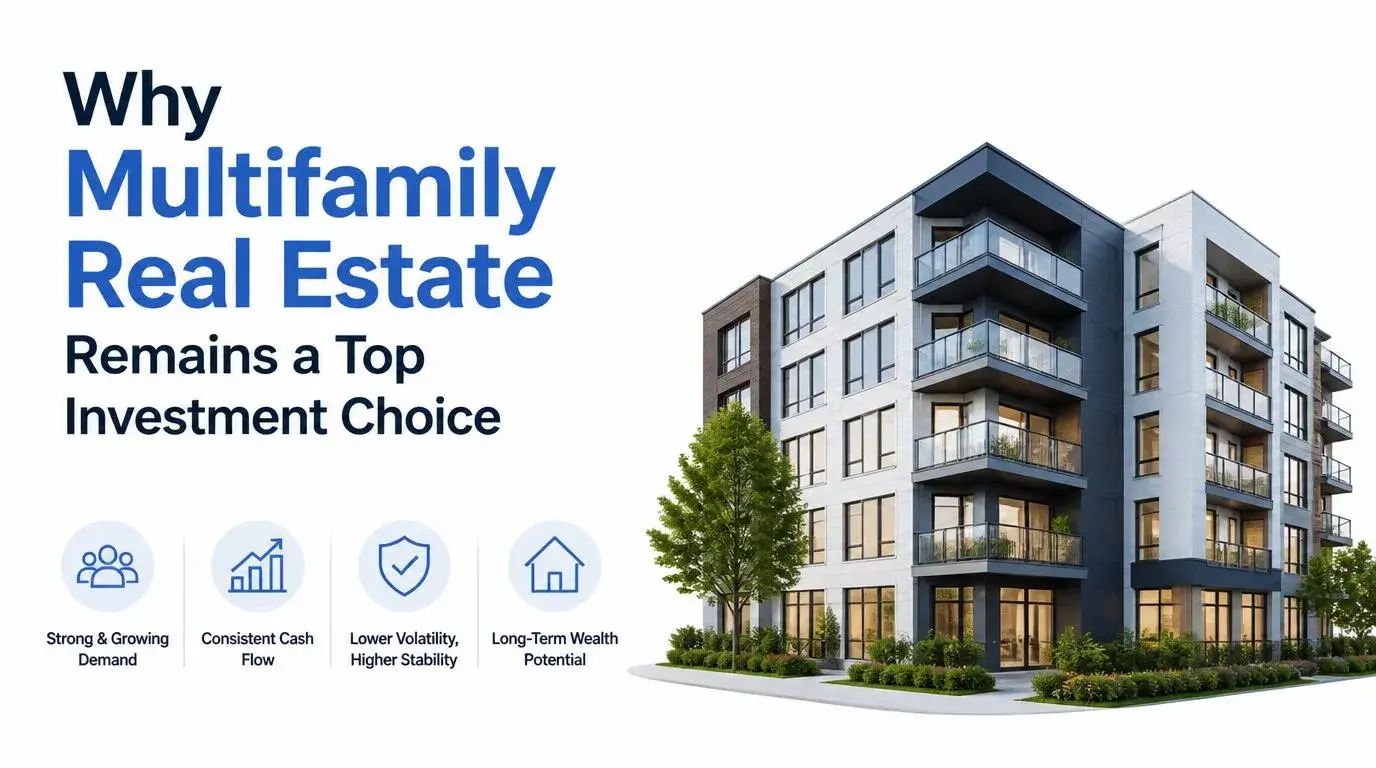
Why Multifamily Real Estate Remains a Top Investment Choice
The simple answer to why multifamily real estate remains a top investment choice in 2026 comes down to three immutable forces: people always need a place to live, renters are multiplying faster than homeowners, and apartment buildings offer efficiencies that single-family rentals cannot match. While office and retail properties struggle with vacancy and valuation resets, multifamily continues to deliver consistent cash flow, resilient rental demand, and occupancy rates that have stayed above 94% nationally for six consecutive years. Even with interest rates at 5.5–6.5%, well-located apartment buildings in growing markets pencil out positive leverage and attractive risk-adjusted returns.
But the case for apartments goes deeper than simple supply and demand. Multifamily offers economies of scale (one roof, one parking lot, one landscaping contract for 50 families), professional management that optimizes revenue and controls expenses, and financing advantages through government-backed agencies (Fannie Mae, Freddie Mac, FHA). During the 2008 financial crisis, multifamily values declined half as much as single-family homes. During the 2020 pandemic, 97% of apartment tenants continued paying rent. That durability—across economic cycles, across interest rate environments, across crises—is why multifamily real estate remains a top investment choice for everyone from first-time syndicators to the world’s largest pension funds. Let’s examine the data, the math, and the strategies that make apartments the bedrock of commercial real estate investing.
What Makes Multifamily Different From Other Real Estate Asset Classes?
Before diving into the numbers, understanding why multifamily real estate remains a top investment choice requires comparing it to its alternatives. Each asset class has its own risk-reward profile, and multifamily consistently ranks near the top for risk-adjusted returns.
Multifamily vs. Single-Family Rentals (SFR): SFR offers lower entry costs ($200k–400k per property) and easier financing (conventional residential loans). But SFR also means 100% of your income depends on one tenant. If that tenant stops paying or the property needs a new roof, your cash flow goes to zero. Multifamily spreads risk across multiple tenants. A 50-unit building can lose 5 tenants and still cash flow. Multifamily also offers economies of scale: one property manager handles all 50 units, one maintenance crew services all buildings, one insurance policy covers everything. Per-unit operating costs in multifamily are typically 20–30% lower than SFR.
Multifamily vs. Office: Office properties are in structural decline. Remote and hybrid work have permanently reduced demand. National office vacancy exceeds 18%, and many buildings are worth 50–70% of their 2019 values. Multifamily, by contrast, benefits from remote work—people moving from expensive coastal cities to Sun Belt apartments, and working from home means they value their apartment more, justifying higher rents.
Multifamily vs. Retail: Brick-and-mortar retail continues to face online competition. While grocery-anchored and necessity-based retail survives, mall-based and apparel retail struggles. Multifamily has no online competitor—you cannot Amazon Prime a place to live.
Multifamily vs. Industrial: Industrial (warehouses, distribution centers) has been the best-performing commercial real estate sector over the past five years. But industrial requires massive capital ($10M+ for a single building), has long lease-up periods, and depends on the health of logistics and manufacturing. Multifamily offers lower entry points ($1M–5M for smaller buildings) and more predictable, stable demand.
Multifamily vs. Self-Storage: Self-storage has high margins and low operating costs, but it’s also highly competitive and sensitive to consumer discretionary spending. Multifamily addresses a basic human need—shelter—making it more recession-resistant.
This comparative advantage—essential need, multiple income streams, operating efficiencies, and financing availability—is why multifamily real estate remains a top investment choice across market cycles.
Recession-Resistant Demand: The Ultimate Hedge
The most compelling argument for why multifamily real estate remains a top investment choice is its performance during economic downturns. History is clear: people keep paying rent even when they lose jobs.
During the 2008–2010 Great Recession, national multifamily occupancy never fell below 90% (compared to 70% for office and 75% for retail). Rents declined 5–10% but recovered within 24 months, while home prices fell 30% and took 6 years to recover. During the 2020 COVID pandemic, despite widespread job losses, 97% of apartment tenants paid rent in full each month. Government stimulus helped, but even without it, eviction moratoriums only affected a small fraction of non-paying tenants. Multifamily proved its resilience.
Why does demand hold up? When people lose jobs or face financial stress, they don’t become homeless—they downsize. They move from a $2,500/month luxury apartment to a $1,500/month Class B unit. They move from a single-family home they can no longer afford back into an apartment. Recessions actually increase rental demand as homeownership becomes unattainable and household formation (young adults moving out of parents’ basements) continues. In the last three recessions, the homeownership rate declined by 2–4 percentage points, pushing millions of households into the rental pool.
This counter-cyclical demand is the secret sauce. Most investments lose value in recessions. Multifamily may see temporary rent declines, but occupancy stays high, cash flow continues (albeit reduced), and the asset survives to recover. For investors with long time horizons, this durability is priceless.
Economies of Scale: Why Bigger Is Often Better
Another key to why multifamily real estate remains a top investment choice is the power of scale. Operating 50 apartments under one roof costs far less per unit than operating 50 single-family homes scattered across a city.
Operating Expense Comparison (per unit per year): For a 50-unit apartment building, typical operating expenses (excluding debt service) run $4,000–6,000 per unit annually. For a single-family rental, expenses run $5,000–7,500 per unit. The 20–30% savings in multifamily come from: one property manager overseeing 50 units instead of 50 separate managers; one maintenance technician for the entire building (versus driving between properties); bulk purchasing of supplies (lightbulbs, paint, filters); one roof, one parking lot, one landscaping contract; lower per-unit insurance costs (commercial policies are cheaper per door); and shared utilities (hallway lighting, laundry room water).
These savings flow directly to net operating income (NOI). Higher NOI means higher property value (Value = NOI ÷ Cap Rate). And higher value means more equity when you refinance or sell.
Scale also enables professional management. A single-family landlord might self-manage or hire a small operator. A 200-unit apartment building can support a full-time property manager, leasing agent, maintenance supervisor, and assistant. Professional management means better tenant screening (lower bad debt), faster maintenance response (lower turnover), and optimized revenue (dynamic pricing for rents). The difference between amateur and professional management can be 200–300 basis points of NOI—the difference between a good investment and a great one.
For investors, scale also means you can hire a third-party management company (typically 3–5% of effective gross income for large properties, versus 8–12% for single-family). That 5% savings on a $2M revenue property is $100,000 annually—real money.
Financing Advantages: Agency Debt and Beyond
Multifamily enjoys financing advantages that other commercial real estate sectors don’t. This is a major reason why multifamily real estate remains a top investment choice even when interest rates rise.
Fannie Mae and Freddie Mac (Agency Lending): These government-sponsored enterprises have mandates to provide liquidity to the multifamily market. They offer 5, 7, and 10-year fixed-rate loans at spreads of 170–220 basis points over comparable Treasuries. For a 10-year fixed agency loan in 2026, expect rates of 5.75–6.25% for well-qualified sponsors—substantially lower than conventional commercial real estate loans (6.5–7.5%). Agency loans are non-recourse (no personal guarantee) for properties with 65% or lower loan-to-value, protecting your personal assets. Terms are forgiving: 30-year amortization (lower monthly payments than 20- or 25-year), interest-only periods available for value-add properties, and prepayment flexibility (yield maintenance or defeasance, not hard prepayment penalties).
FHA Multifamily Loans (Section 221(d)(4) and 223(f)): For larger properties (5+ units), FHA offers the cheapest financing in the country. Section 221(d)(4) loans for new construction or substantial rehabilitation offer 40-year fixed rates at 20–30 basis points below agency debt. Section 223(f) for existing properties offers 35-year fixed rates. The trade-off: the application process takes 9–12 months (versus 60–90 days for agency), and construction oversight is intense. But for patient investors, FHA financing can transform a deal’s economics.
Bridge and Hard Money: For value-add properties that don’t yet qualify for agency or FHA debt (due to low occupancy or deferred maintenance), bridge lenders provide short-term (12–36 month) floating-rate loans at SOFR+400–600 basis points (roughly 7–9% in 2026). These allow you to buy distressed properties, renovate, stabilize, then refinance into permanent agency debt. The strategy is central to multifamily value-add investing.
CMBS and Life Company Loans: For properties over $10M, commercial mortgage-backed securities (CMBS) and life insurance companies offer alternative financing. CMBS rates are slightly higher than agency but offer more flexibility (higher leverage, interest-only options). Life company loans are the most conservative (lower leverage, strict underwriting) but have the lowest rates and longest terms (15–20 years fixed).
Compare this to single-family rentals: your only options are conventional investment loans (6.5–7.5%, 20–25% down, recourse, 30-year term) or private lenders (higher rates, shorter terms). The depth and variety of multifamily financing options reduce risk and increase returns—another reason institutional capital prefers apartments.
Value-Add Potential: Forcing Appreciation in Any Market
One of the most powerful features of multifamily is the ability to force appreciation through operational improvements. This is why multifamily real estate remains a top investment choice for active investors who don’t want to rely on market luck.
How Value-Add Works: Buy an underperforming apartment building at a discount (typically Class B or C, 1980–2000 vintage). The property has deferred maintenance, below-market rents, and inefficient operations. Implement a value-add business plan over 24–36 months: renovate units (new flooring, countertops, fixtures, appliances), upgrade common areas (leasing office, gym, pool, laundry), improve management (better tenant screening, faster maintenance, revenue management), and optimize expenses (submeter utilities, bulk internet, energy-efficient lighting). Raise rents 20–40% over 2–3 years. Net operating income (NOI) increases. Property value = NOI ÷ Cap Rate. Higher NOI + potentially compressed cap rate (due to improved quality) = significantly higher value.
Real-World Example: 100-unit building purchased for $8,000,000 ($80,000/unit). Current rent $900/unit, current NOI $560,000 (7.0% cap rate). Value-add plan: spend $15,000/unit ($1,500,000) on renovations over 24 months. Raise rents to $1,200/unit (33% increase). New gross rent $1,440,000. Expenses 45% of EGI = $648,000. New NOI $792,000. At a 6.5% cap rate (compressed due to improved quality), new value = $12,184,615. Total gain $4,184,615. Invested equity: 30% down ($2,400,000) plus $1,500,000 renovations = $3,900,000. Return on invested capital 107% over 3 years, plus cash flow during renovation (though typically negative in year one, positive in years two and three).
This forced appreciation works even if market cap rates stay flat or expand slightly. You’re not betting on market timing—you’re creating value through execution. That’s the difference between speculating and investing.
Tax Advantages: Why Multifamily Beats Stocks for Wealth Building
The tax code is heavily skewed toward real estate investors, and multifamily offers the most generous benefits. This is why multifamily real estate remains a top investment choice for high-net-worth individuals and family offices.
Depreciation: Residential rental property depreciates over 27.5 years. On a $10,000,000 apartment building with $8,000,000 allocated to building (land value excluded), annual depreciation is $291,000. This paper loss reduces your taxable rental income, often to zero or negative, while you collect actual cash flow. For investors in the 37% tax bracket, $291,000 in depreciation saves $107,000 in taxes annually.
Cost Segregation: For properties over $1M, a cost segregation study reclassifies building components (carpet, appliances, cabinets, lighting, landscaping) as 5, 7, or 15-year property instead of 27.5 years. This accelerates depreciation, potentially creating a six-figure tax loss in year one. On a $5,000,000 property, a cost segregation study costing $5,000–10,000 might identify $1,500,000 of 5-year property, generating $300,000 in first-year depreciation (versus $55,000 without the study). The tax savings often exceed the study cost by 10–20x.
Bonus Depreciation: For qualified improvement property placed in service before 2026, you can deduct 60% in year one (2024–2025, phasing down to 20% in 2026). Congress may extend or modify this, but as of 2026, bonus depreciation remains a powerful tool for value-add renovations.
1031 Exchanges: When you sell a multifamily property, you can defer all capital gains taxes by rolling the proceeds into a larger property within 180 days. You can do this repeatedly, trading up from a 20-unit building to a 50-unit to a 200-unit over decades, never paying taxes until you finally sell (or your heirs inherit with a stepped-up basis). This is how apartment investors build empires without ever writing a check to the IRS.
Pass-Through Deduction (Section 199A): If your taxable income is under $191,950 (single) or $383,900 (married), you may deduct 20% of qualified business income from rental real estate. For a high-income investor, this effectively reduces your tax rate on rental profits from 37% to 29.6%.
Real Estate Professional Status: If you spend 750+ hours per year on real estate activities (acquisition, management, renovations, leasing) and materially participate, rental losses become “non-passive” and can offset W-2 wages and business income—not just rental income. This is a massive benefit for full-time investors but requires meticulous documentation.
Compare this to stock investing: dividends are taxed as ordinary income (up to 37%) or qualified dividends (15–20%). Capital gains are taxed at 15–23.8% when you sell. There’s no depreciation, no 1031 exchange, no cost segregation. For wealth building, real estate’s tax advantages are unmatched.
The Supply-Demand Imbalance: A Decade-Long Tailwind
Long-term demographic trends explain why multifamily real estate remains a top investment choice for patient capital. The math is simple: more renters are being created each year than new apartments are being built.
Household Formation: The US adds approximately 1.5 million new households annually. Of those, roughly 40% become renters (down from 50% pre-pandemic due to remote work enabling homeownership, but still 600,000 new renter households per year). To house 600,000 new renter households, the US needs 600,000 new apartment units annually.
New Supply: Multifamily construction has averaged 350,000–400,000 units annually over the past five years. That’s a 200,000–250,000 unit annual deficit. This deficit has persisted since 2015, creating a cumulative shortage of over 2 million apartment units. Even if construction accelerates, high material costs, labor shortages, and tight financing make 500,000+ units annually unlikely.
Homeownership Affordability Crisis: The median home price is now 5.5x median household income—the highest ratio since 2007. The 30-year mortgage rate remains above 6%. For millions of Americans, homeownership is simply unaffordable. They will rent longer, and many will rent forever. This structural shift permanently increases rental demand.
Millennials and Gen Z: Millennials (age 28–43) are the largest generation in US history, and they’re still forming households. Many delayed marriage, children, and home buying due to student debt and the 2008 recession. They’re now entering prime household formation years. Gen Z (age 18–27) is even larger than Millennials and will drive rental demand for the next decade.
Immigration: Legal immigration has returned to pre-pandemic levels (1 million+ annually). Most immigrants rent for their first 5–10 years in the US. This adds another 100,000–200,000 renter households annually.
Supply-demand imbalances don’t last forever, but this one has at least another 5–10 years. For investors, that means sustained rent growth (3–5% annually in most markets), low vacancies (under 5%), and steady appreciation. Timing the multifamily market is less important than being in it.
Market Performance Data: Multifamily Outperforms Over Time
If you need hard evidence for why multifamily real estate remains a top investment choice, look at the returns. Data from NCREIF (National Council of Real Estate Investment Fiduciaries) shows multifamily has outperformed all other commercial real estate sectors over 10, 20, and 30-year horizons.
10-Year Annualized Returns (2015–2025): Multifamily 9.8%, Industrial 11.2%, Office 5.4%, Retail 4.1%, All Property Average 7.2%. Multifamily trails only industrial, which had a once-in-a-generation e-commerce boost.
20-Year Annualized Returns (2005–2025): Multifamily 8.9%, Industrial 8.4%, Office 6.1%, Retail 5.7%, All Property Average 7.1%. Multifamily leads over two decades.
30-Year Annualized Returns (1995–2025): Multifamily 9.2%, Industrial 8.7%, Office 7.4%, Retail 7.1%, All Property Average 7.8%. Multifamily leads by a wide margin.
During the 2008–2010 downturn, multifamily total returns (income + appreciation) were -12% versus -35% for office and -40% for retail. During the 2020 pandemic, multifamily returns were +2% versus -15% for office and -20% for retail. Multifamily doesn’t just outperform in good times—it protects capital in bad times.
For individual investors (not just institutions), the data is equally compelling. According to a 2025 study by the National Association of Realtors, real estate investors who owned multifamily properties had a median net worth 2.5x higher than single-family rental owners and 5x higher than non-real estate investors. The reasons: higher cash flow, faster equity accumulation (multiple tenants paying down the same mortgage), and tax advantages.
The data is clear. Multifamily works.
Risks to Understand (And How to Mitigate Them)
No honest analysis of why multifamily real estate remains a top investment choice would ignore the risks. Understanding them is how you avoid them.
Interest Rate Risk: Rising rates increase debt service, potentially turning positive cash flow negative if you’re over-leveraged. Mitigation: use fixed-rate debt (agency loans are fixed), stress-test at 200 basis points higher than today’s rates, and maintain 12+ months of debt service reserves. Avoid floating-rate debt unless you have interest rate caps or a very short hold period.
Market-Specific Supply Glut: Some submarkets (Nashville, Austin, parts of Dallas) have seen construction booms that temporarily outpace demand, leading to rent concessions and higher vacancies. Mitigation: analyze building permits and delivery schedules before investing. Avoid submarkets with 5%+ of existing inventory under construction. Focus on infill locations with land constraints that limit future supply.
Management Risk: Bad property management destroys value: high turnover, low occupancy, deferred maintenance, legal liabilities. Mitigation: hire third-party managers with 10+ years local experience and audited financial statements. Check references from other owners. Visit properties unannounced. Replace underperformers quickly—bad management compounds losses.
Economic Downturn (Rent Decline): In severe recessions, rents may decline 5–15% and vacancies may rise to 10–15%. Mitigation: underwrite with 10% vacancy and 0% rent growth in your base case. If the deal still works, you’re protected. Maintain 6–12 months of operating reserves. Buy in diversified markets (not single-industry towns) with recession-resistant employment (healthcare, education, government).
Regulatory Risk: Rent control, eviction moratoriums, and tenant protection laws are spreading from blue states to some purple cities. Mitigation: invest in landlord-friendly states (Texas, Florida, Georgia, North Carolina, Tennessee, Arizona, Indiana, Ohio). Monitor local elections and ballot initiatives. Avoid cities with active rent control movements (Portland, Minneapolis, St. Paul, Denver, Seattle).
Hidden Physical Risks: Deferred maintenance (roof, HVAC, plumbing, electrical, parking lot) can cost 10–30% of purchase price to remediate. Environmental issues (mold, asbestos, lead paint, underground storage tanks) can be even worse. Mitigation: order a Phase I environmental assessment ($3,000–5,000) and property condition assessment ($5,000–10,000) before closing. Build a capital expenditure reserve of $2,500–3,500 per unit annually.
None of these risks are fatal if you plan for them. The worst losses happen to investors who ignore risks, not those who face them head-on.
How to Start Investing in Multifamily at Any Budget
One of the best aspects of multifamily is its accessibility. Why multifamily real estate remains a top investment choice for investors at all wealth levels is the range of entry points.
Budget $50,000–100,000 (Small Multifamily House Hack): Buy a duplex, triplex, or fourplex using an FHA loan (3.5% down) or conventional owner-occupant loan (5% down). Live in one unit, rent the others. Your tenants’ rent covers most or all of the mortgage. After one year, move out, rent your unit, and repeat. This is how most multifamily investors start. Example: $400,000 fourplex, FHA 3.5% down = $14,000 plus closing costs ($25,000 total). Three rented units at $1,000 each cover $3,000 of your $3,200 PITI. You pay $200/month to live there. After one year, rent the fourth unit for $1,000, and the property cash flows $800/month.
Budget $100,000–250,000 (Limited Partner in Syndication): Join a multifamily syndication as a passive investor. A sponsor (general partner) finds and operates a 50–200 unit property. Limited partners (you) provide capital and receive 70–80% of profits. Minimum investments typically $50,000–100,000. Expected returns: 5–8% annual cash-on-cash plus 15–20% IRR at sale (3–7 year hold). Vet sponsors carefully: 7+ years experience, 10+ deals completed, audited returns, references.
Budget $250,000–500,000 (Small Multifamily Pure Investment): Buy a 5–20 unit building with conventional commercial financing (25–30% down). Self-manage or hire a manager. Focus on Class B properties in B neighborhoods. Example: $1,500,000 12-unit building, 25% down = $375,000 plus closing costs. Each unit rents for $1,100 ($13,200/month). Expenses $6,600/month (50% rule). Debt service on $1,125,000 at 6.5% = $7,100/month. Cash flow negative $500/month? Need lower price or higher rents. At $1,300,000 purchase ($1,300,000 price, 25% down $325,000, loan $975,000 at 6.5% = $6,160/month). Expenses $6,600. Rent $13,200. Cash flow $440/month ($5,280/year). Cash-on-cash 1.6%—too low. Need better cap rates. Small multifamily cash flow is challenging at current prices. Better to partner on larger deals or wait for cap rates to expand.
Budget $500,000–2,000,000 (Small Multifamily Value-Add): Same as above but targeting distressed properties requiring renovation. Buy at 8–9% cap rate (low price relative to NOI), renovate, raise rents, refinance at 6–7% cap rate, recoup capital. This is the BRRRR method at scale.
Budget $2,000,000+ (Medium Multifamily Syndicator/Sponsor): Raise additional capital from partners and acquire 50–200 unit properties. You provide 10–20% of equity, limited partners provide 80–90%. You earn acquisition fees, asset management fees, and 20–30% of profits. This is institutional-level investing and requires significant experience, credibility, and network.
Regardless of budget, the path is the same: start small, learn the asset class, build a team, scale gradually. Multifamily rewards patience and punishes hubris.
Conclusion: The Case for Multifamily in 2026 and Beyond
After reviewing the data—recession-resistant demand, economies of scale, financing advantages, value-add potential, tax benefits, supply-demand imbalances, and historical performance—the answer to why multifamily real estate remains a top investment choice is clear. Apartments offer a combination of current cash flow, long-term appreciation, tax efficiency, and risk mitigation that no other asset class can match.
Yes, interest rates are higher than 2021. Yes, prices are higher than 2019. Yes, finding deals requires more work than during the zero-interest-rate era. But the fundamentals have never been stronger. The US needs 600,000 new apartment units annually and builds only 400,000. That 200,000-unit annual deficit compounds year after year. Millennials and Gen Z will rent for years. Immigration continues. Homeownership remains unaffordable for millions.
For investors who underwrite conservatively, use reasonable leverage (65–75% LTV), maintain substantial reserves, and partner with experienced operators, multifamily offers 8–12% cash-on-cash returns and 12–18% IRRs over 5–7 year holds. Those returns, combined with tax benefits that effectively increase after-tax returns by 2–4% annually, create a compelling wealth-building vehicle.
Is multifamily risk-free? No investment is. But compared to stocks, bonds, single-family rentals, office, retail, and most alternatives, multifamily offers the best risk-adjusted returns for patient capital. That’s not a prediction—it’s a pattern observed over 50+ years of market cycles. And patterns matter.
Your next step: educate yourself (books, podcasts, courses), network with multifamily investors in your area (meetups, conferences, LinkedIn), analyze 20+ deals using real underwriting, and take action. Not tomorrow. Not when rates drop. Today. The best time to invest in multifamily was 10 years ago. The second-best time is now.
FAQ
1. Why does multifamily real estate remain a top investment choice compared to single-family rentals?
Multifamily offers multiple income streams (if one tenant leaves, others still pay), economies of scale (lower per-unit operating costs), professional management, and agency financing (Fannie/Freddie) with better terms. Single-family rentals concentrate 100% of income in one tenant and lack operating efficiencies. For the same capital, multifamily typically generates higher cash-on-cash returns and lower risk per dollar invested.
2. Are multifamily properties still profitable with today’s high interest rates?
Yes, but you must buy right. Focus on value-add properties at 7–8% cap rates (Class B/C, deferred maintenance). Use fixed-rate agency debt (5.75–6.25% for strong sponsors). Underwrite with 10% vacancy and 0% rent growth in your base case. If the numbers work at those levels, the deal will cash flow. Avoid core properties at 4.5–5.5% cap rates—they won’t cash flow at today’s rates unless you have all cash.
3. How much capital do I need to start investing in multifamily?
As little as $50,000–100,000 via house hacking (buy a duplex/fourplex with FHA 3.5% down, live in one unit, rent the others). For pure investment (non-owner-occupied), $150,000–250,000 allows you to buy a small 5–20 unit building (25% down) or invest as a limited partner in a syndication (typical minimum $50,000–100,000). For larger deals ($50M+), limited partner minimums are often $250,000–1,000,000.
4. What is a good cap rate for multifamily in 2026?
In primary Sun Belt markets (Dallas, Charlotte, Atlanta, Phoenix), Class A core: 4.5–5.0%, Class B value-add: 5.5–6.25%, Class C distressed: 6.5–7.5%. In secondary Midwest markets (Indianapolis, Columbus, Kansas City), add 0.5–1.0% to those ranges. Focus on value-add cap rates (6–7%) for the best risk-adjusted returns. Cap rates below 5.5% are too tight for 6–7% debt costs unless you have significant equity or expect exceptional rent growth.
5. Can I lose money in multifamily real estate?
Yes. Over-leveraging (80%+ LTV), buying in declining markets, overpaying for properties, poor management, or using floating-rate debt without caps can destroy returns. The 2008 crisis saw 30–40% value declines in some overbuilt multifamily markets. But those who bought at reasonable leverage, maintained reserves, and held through the downturn recovered fully within 3–5 years. Risk is manageable but not eliminable.
6. How do I find multifamily deals as a new investor?
Start with online marketplaces (Crexi, LoopNet, Roofstock), but the best deals are off-market. Build relationships with commercial brokers who specialize in multifamily in your target market. Attend local REIA (Real Estate Investor Association) meetings. Send direct mail to owners of underperforming properties (look for high vacancy, code violations, outdated marketing). Use data services (Costar, Reonomy, PropStream) to identify distressed properties. Partner with experienced investors who have access to deals. Be persistent—finding good deals is the hardest part of multifamily investing.
Written by Jasica Jhon
Thomas Jhon is a senior real estate investment analyst and finance journalist with over a decade of experience covering commercial real estate markets across the United States. Formerly a due diligence officer at a $2B private equity firm, Thomas now contributes to leading real estate publications and advises family offices on multifamily acquisition strategies. His expertise spans cash flow modeling, interest rate risk management, and value-add repositioning in Sun Belt markets. Thomas holds a Master’s in Real Estate Finance from NYU Schack Institute and is a frequent speaker at NMHC conferences.
Disclaimer
The information provided in this article is for informational and educational purposes only and should not be considered financial, investment, legal, or real estate advice. Real estate investments involve risks, and market conditions may change over time.
Readers should conduct independent research and consult licensed financial advisors, real estate professionals, mortgage specialists, attorneys, or tax experts before making investment decisions.